Summary
Motivation
- Robot demonstrations are slow and expensive to collect. Videos of a human hand doing the task are cheap: a camera and a few seconds per demonstration.
- A hand is not a robot, so the video cannot be replayed as robot actions directly. Something in between has to carry the intent of the motion from one body to the other.
Concept
- Can we drive a robot to solve a task in simulation, given just an image of the scene in the real world and the text instruction?
- Use a world model to plan how to solve the task by rolling out videos and generating the flow of key points. Then use the generated flow of key points to condition and drive a policy in simulation.
Personal Motivation
- Most of my PhD research has focused on reinforcement learning for locomotion, and more recently on typical VLA architectures for industrial tasks.
- I have had little opportunity to explore video world models or real2sim research.
- The same day I read about the internship challenge, my collaborator on my most recent work showed me the paper Hydra-0: Action Flow for Generalist World Modeling and Control.
- This challenge was a great opportunity to explore these technologies I had not worked with before, while using my experience with VLAs along the way.
- I have really enjoyed this past week of work.
Method
generated video + planned action flow
wrist camera obs
First frame + instruction
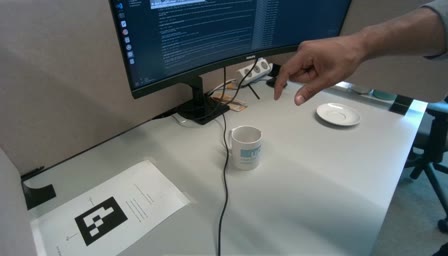
text instruction“pick up the mug and put it on the plate”
World action modelCosmos rolls out video + key-point flow
Policyflow-conditioned, 32 actions
Simulation
choose episode
Results
| flow | train (80) | test (20) | failed (46) | |
|---|---|---|---|---|
| Simulation Policies | no flow: baseline, both cameras | 84.4 ± 1.6 | 77.8 ± 1.7 | 42.1 ± 1.6 |
| no flow: baseline, wrist camera | 59.1 ± 1.2 | 36.6 ± 2.9 | 24.9 ± 1.7 | |
| no flow: baseline, no cam obs (state only) | 0.7 ± 0.4 | 0.2 ± 0.4 | 0.3 ± 0.3 | |
| flow-conditioned, ground truth flow (wrist cam obs) | 93.5 ± 0.4 | 73.0 ± 1.8 | 6.8 ± 0.4 | |
| flow-conditioned, ground truth flow (no cam obs) | 88.3 ± 1.0 | 62.2 ± 1.9 | 3.8 ± 0.4 | |
| End2End Planning and Execution | ours | 58.2 ± 2.9 | 27.8 ± 8.0 | 4.8 ± 0.9 |
| ours (no cam obs) | 59.2 ± 1.9 | 28.8 ± 5.7 | 2.6 ± 2.1 |
Limitations
- The major limitation of this work is that it is only demonstrated on a single, simple task.
- The flow-conditioned policy does not seem to take full advantage of the wrist camera. With ground truth flow the camera helps (73.0 % vs 62.2 % on test), but with the WAM's plans the policy without camera observations does as well (28.8 % vs 27.8 %, within the run-to-run spread). This suggests the flow + camera policy over-attends to the flow and does not use the camera to correct an imperfect plan.